Multiclass vs Multilabel Classification Explained
Binary, multiclass, and multilabel classification: one label vs many labels, with real examples and when to use each.
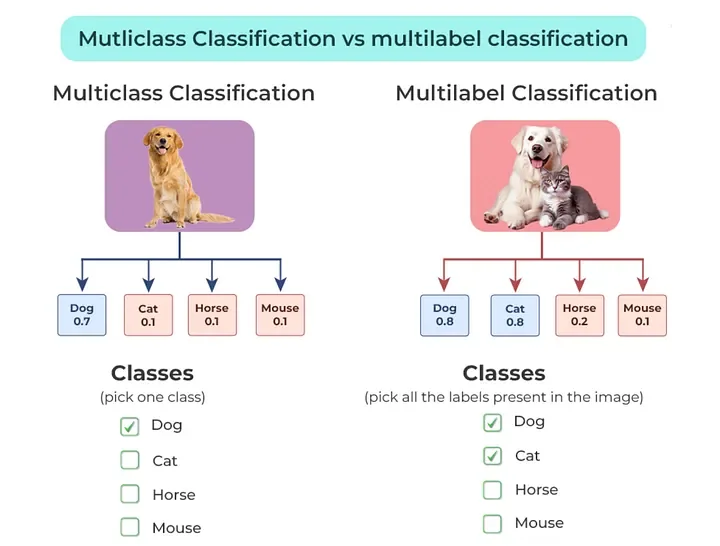
The Core Distinction
Both approaches classify inputs into predefined categories. The difference is how many labels are allowed per prediction:
- Multiclass: each input gets exactly one label from N options
- Multilabel: each input can get any number of labels from N options simultaneously
This distinction affects your output layer (softmax vs sigmoid), loss function (cross-entropy vs binary cross-entropy per label), and evaluation metrics.
Multiclass Classification
1 Binary Classification
A special case of multiclass with exactly two classes. After classification, the result can only be one of two options. The model outputs a single probability — above 0.5 is class A, below is class B.
Examples:
- Spam detection — spam or not spam
- Sentiment analysis — positive or negative
- Disease detection — disease present or absent
- Gender classification — from a fixed set of two
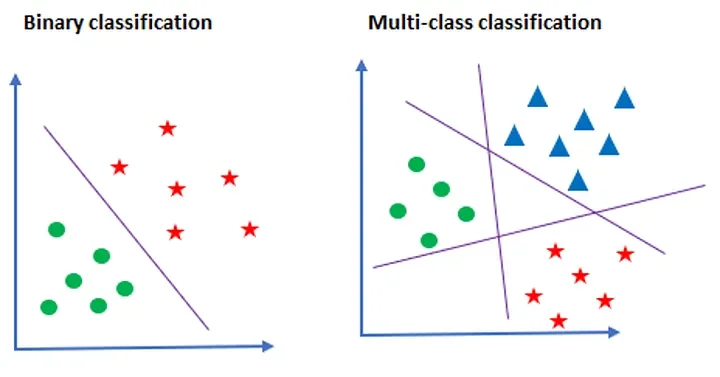
2 Multiclass Classification
More than two classes, but still exactly one label per prediction. The model outputs a probability distribution across all classes (via softmax) and selects the highest. Image tasks like MNIST are classic CNN territory.
Examples:
- Digit recognition (MNIST) — classify as 0, 1, 2, … 9
- Multi-sentiment analysis — very negative, negative, neutral, positive, very positive
- Animal classification — cat, dog, bird, fish, …
- Land-use detection — urban, forest, water, agricultural
- Traffic sign classification — 30km/h, stop, yield, …
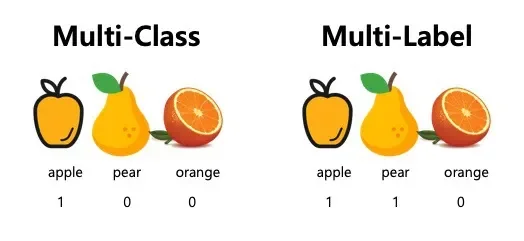
Multilabel Classification
Multilabel allows instances to carry multiple labels simultaneously. The model outputs an independent sigmoid probability per class — each class is a separate binary decision. Zero, one, or many labels can be active at once.
Multilabel Examples
- Dog classification: breed (Labrador) + country of origin (UK) + gender (male) — three independent labels from three attribute sets
- Music genre tagging: a track can be classical-rock, indie-devotional, or jazz-pop — multiple genres simultaneously
- Object detection: an image contains dogs + humans + water + boats — all labels are correct, none excludes the others
- Document tagging: an article about climate policy is tagged with 'climate', 'policy', 'government', 'science' all at once
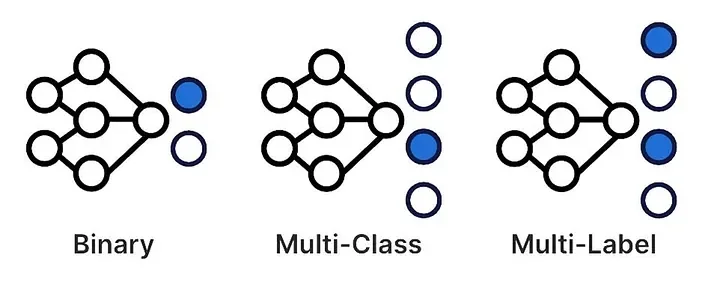
Key Takeaways
- Multiclass = one label per instance. Use softmax output + categorical cross-entropy loss.
- Multilabel = any number of labels per instance. Use sigmoid output per class + binary cross-entropy per label.
- Binary classification is a special case of multiclass with N=2.
- Evaluation differs: multiclass uses accuracy, top-k accuracy; multilabel uses Hamming loss, F1 per label, subset accuracy.
- Real-world signals are often multilabel — images, documents, audio naturally contain multiple independent attributes.
Frequently Asked Questions
What is the difference between multiclass and multilabel classification?
Multiclass: each instance gets exactly one label from N options (e.g., digit recognition: 0–9). Multilabel: each instance can have any number of labels simultaneously (e.g., a photo tagged 'dog', 'outdoor', 'grass' all at once).
What is binary classification?
Binary classification is a special case of multiclass with exactly two classes. Each instance is classified as one of two outcomes — spam or not spam, positive or negative, disease or no disease.
What are examples of multilabel classification?
Dog breed + country of origin + gender simultaneously; music genre tagging (classical-rock, indie-devotional); image object detection identifying multiple objects; document tagging with multiple topics. Any task where an instance naturally belongs to multiple categories at once.
When should you use multilabel instead of multiclass?
Use multilabel when your data can have multiple correct labels simultaneously. If a song belongs to exactly one genre, that's multiclass. If it can blend multiple genres, that's multilabel. The key question: can one input legitimately have two or more correct labels?